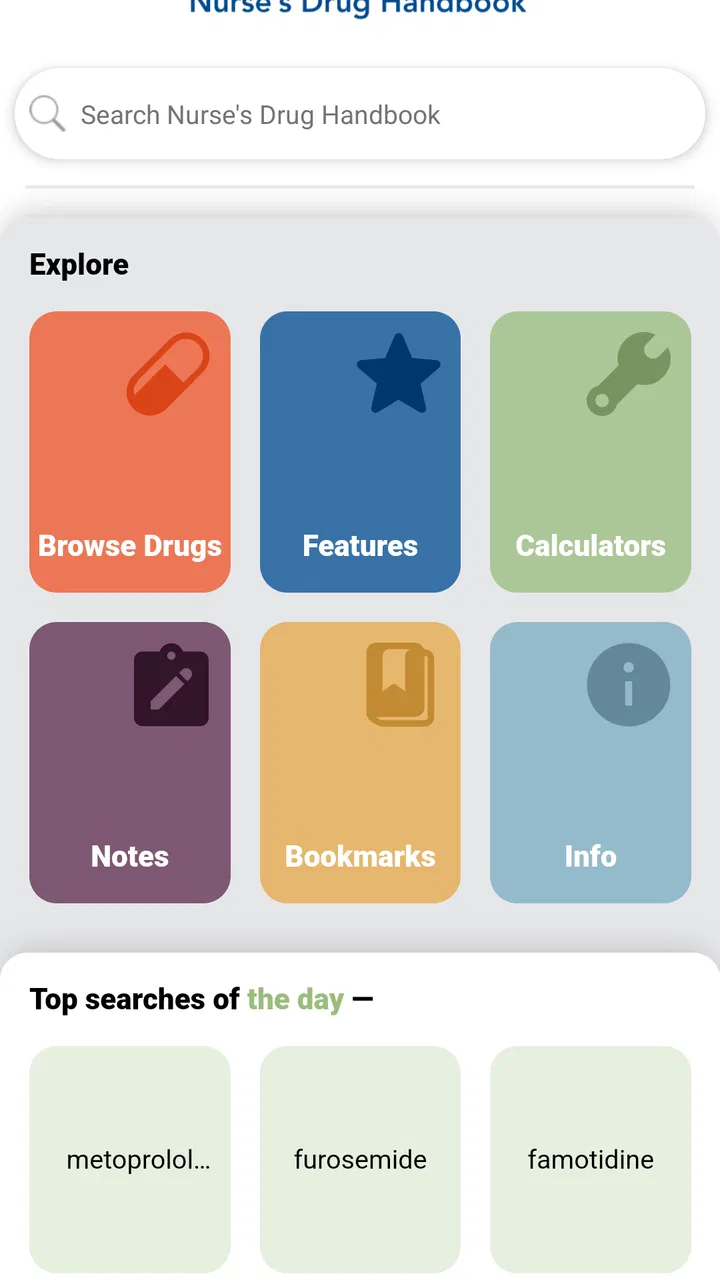
Nurse's Drug Handbook
- 4.0
- Rating
- 100.00K
- Installs
- Free
- Price

 Analysis by App-foxy
When I need to check a medication quickly, I want a reference that gets me to useful nursing information without making me search through a general health website first. Nurse's Drug Handbook is built for that particular job. It is a medical app from AtmosphereApps, and I found its strongest appeal in the way it treats drug information as a practical nursing reference rather than as a broad symptom checker or a patient-focused wellness tool.
I would not use it as a substitute for a prescriber, pharmacist, local protocol, or clinical judgment. I would use it as a preparation and cross-checking aid: something to consult before a medication round, while reviewing a drug I do not use often, or when I want a concise reminder of the points that matter in nursing practice. That distinction is important, because the app is most useful when it supports a professional workflow instead of pretending to make the decision for you.
The app is free to install and is suitable for Everyone, although some content is available through in-app purchases ranging from around ten dollars to around twenty-five dollars per item. It has a 4.0 average from around 2.4 thousand ratings, with over 100 thousand installs. Those figures suggest a reasonably established audience, but I would still judge it by how well it fits my own way of checking medicines, not by popularity alone.
You May Also Like

 Blood Strike: 2.5 Anniversary
Blood Strike’s Loadouts Turn Every Drop Into a Tactical Gamble
A close look at Blood Strike’s custom loadouts: how fast access to signature weapons reshapes its battle royale rhythm, rewards preparation, and narrows the gap between fights.

 Pandora - Music & Podcasts
Pandora’s Music Is Easy to Start, but Harder to Recover
Pandora’s strength is its low-effort path from a seed to a station. Its weak spot is how much confidence it asks you to place in connection, setup, and quiet recovery.

 8 Ball Pool
 Is Built on Rivalries, Rematches, and Routine
A close look at the rivalries, rematches, shared routines, and unanswered safety questions that turn a quick pool match into a persistent mobile community.

 Samsung Music
’s Quiet Strength Is Playing What You Already Own
Its reach comes less from spectacle than from dependable access to a personal library. That simplicity is both the app’s strongest retention engine and its ceiling.

 AccuWeather: Weather Radar
AccuWeather Review: A Quick, Clear Forecast for Everyday Decisions
For everyday plans, the best forecast is the one you can understand quickly. AccuWeather makes rain timing, radar, and local conditions easy to act on, with a few trade-offs.

 Hill Climb Racing
Why Hill Climb Racing Still Turns Crashes Into One More Run
A tiny car, a bumpy hill and one more upgrade: Hill Climb Racing keeps resurfacing because its simple chaos makes every near-miss feel personal.
More From Our News Desk



How I Decide Whether a Drug Reference Is Worth Keeping
I judge a reference by whether I still reach for it once the first-week curiosity has worn off, not just by how quickly I can browse it on day one. I’ll focus on the habits that make a nursing drug handbook useful over time: choosing a clear reason for each lookup, checking that it fits the task, and knowing when another source should take priority.
Speed matters more than decoration
My first test for a reference app is simple: can I find the medicine I need without wandering through unrelated content? A nursing drug handbook should reduce the time between opening the app and reaching the relevant entry. That makes it different from a general medical search engine, where a medication name may appear beside news articles, advertisements, patient forums, or symptom pages.
Nurse's Drug Handbook makes sense for readers who already know the name of the drug they want to investigate. That is a more focused starting point than asking an app to identify an unknown pill or diagnose a reaction. In a realistic shift scenario, I might be preparing to administer a medication that I have seen before but do not remember well enough to rely on memory. I would search the entry, review the information that affects administration and monitoring, and then compare it with the patient’s order and the procedures used in my workplace.
That workflow is safer than treating a single screen as an instruction sheet. A drug reference can help me notice what deserves attention, but it cannot know every patient-specific factor, the latest local policy, or a change made by the prescribing team. The app earns its place when it helps me ask better questions quickly.
Practicality is the real selling point
The store summary presents it as an up-to-date, practical, easy-to-use nursing drug reference. I read that promise as a focus on usability rather than on entertainment or broad education. The short description, “Nurse's Drug Handbook,” is equally direct. This is not trying to be a complete hospital information system, a medication reminder for families, or a replacement for a formal pharmacology course.
That narrow purpose is a strength. A student reviewing medicines before class, a newly qualified nurse building confidence, or an experienced nurse checking an unfamiliar entry can all benefit from a dedicated reference. I also see value for someone revising terminology: instead of opening several unrelated pages, the user can stay within a resource designed around drugs and nursing decisions.
There is a trade-off, though. A focused handbook is only as useful as its coverage and presentation for the specific medicine in front of me. If I need a complete interaction check, a hospital formulary, specialist dosing guidance, or region-specific prescribing information, I may need another resource as well. I would keep it alongside—not instead of—the references required by my employer or school.
The details I would check before trusting any entry
My advice is to avoid reading a medication entry passively. Before using the information, I would identify the exact medicine, formulation, route, and patient context. Similar names can refer to different products, and a quick glance at a familiar word can create false confidence. The most useful habit is to treat each entry as a checklist for verification rather than as permission to proceed.
I would also check whether the information matches the setting in which I work. A reference may be excellent for learning the general nursing considerations of a drug while still needing to be reconciled with local administration procedures. This is one of the less obvious advantages of using a handbook thoughtfully: it can expose gaps in my preparation, but it cannot close every gap by itself.
For students, I would use the app after reading assigned material, not as the only study source. Looking up a medicine immediately before an exam may help recall, but building a proper understanding requires more than memorizing isolated facts. For working nurses, I would use it to refresh knowledge and prepare for discussion with a pharmacist or prescriber when something does not fit the order or the patient’s condition.
Where this app wins against broad medical alternatives
Its clearest advantage is focus. General health apps are often designed for patients who want to understand symptoms, track health information, or receive lifestyle guidance. Those tools can be friendlier for someone who has been prescribed a medicine and wants a basic explanation. They are not necessarily organized around the questions a nurse asks before, during, and after medication administration.
A handbook-style app also feels more appropriate when I am studying a group of medicines rather than solving one isolated concern. I can move from one drug to another with a clinical purpose in mind, compare the information I am reviewing, and keep my attention on medication knowledge. That is more efficient than repeatedly reformulating searches on a general web browser.
Another advantage is portability. A phone-based reference is easier to carry than a large printed handbook, especially when I am moving between classrooms, wards, or study spaces. I can consult it during preparation instead of waiting until I am back at a desk. The convenience is meaningful, but I would still follow workplace rules about phone use in clinical areas and protect patient privacy while searching.
Where another category may fit better
I would choose a hospital-approved database over this app when the task depends on local formulary rules, institution-specific concentrations, or formal medication administration procedures. A dedicated interaction checker may be the better choice when I am investigating combinations of medicines rather than learning the profile of one drug. A pharmacist remains the better resource when the question involves a complex patient, an unusual reaction, or uncertainty that could affect immediate care.
For a member of the public, a patient-oriented medicine app may be less intimidating. Nurse's Drug Handbook is aimed at nursing reference work, so a person who simply wants plain-language instructions about a prescription may prefer a resource written specifically for patients. I would also skip this app as my primary tool if I am looking for pill identification, appointment management, prescription reminders, or symptom triage. Those are different problems.
The same applies to advanced clinical research. If I need detailed evidence, specialist treatment guidance, or a formal literature search, I would move to a professional database or current guideline. The handbook can be a useful first stop, but it should not be mistaken for every type of medical information service.
The cost of switching and the role of the paid items
Because the app is free to install, the initial decision is relatively easy: I can try its workflow before committing money. That matters for a reference tool because personal search habits vary. One user may find a handbook-style layout natural, while another may prefer a browser, a school library resource, or an employer-provided database.
The in-app purchases change the decision slightly. Individual items cost from around ten dollars to around twenty-five dollars, so I would not buy one automatically just because the free installation is convenient. I would first identify what the paid content adds to my own study or work routine and whether I expect to use it often. A student with limited needs may be satisfied with another reference, while someone who repeatedly consults drug information may find the purchase worthwhile if it provides the depth they need.
There is also a switching cost that has nothing to do with money. Once I learn where I expect to find information in one reference, moving between several apps can slow me down and encourage inconsistent checking habits. My practical approach would be to compare Nurse's Drug Handbook with the reference I already trust, using the same handful of medicines and the same questions each time. I would keep the one that lets me verify information most clearly and reliably in my actual setting.
I would not treat the paid option as a reason to abandon required resources. If my school or workplace supplies a licensed clinical database, that resource may remain the main authority for formal decisions. The app can still be valuable as a portable supplement, especially for revision and quick preparation, but convenience should never outrank the source required by local policy.
Compatibility, maintenance, and everyday usability
The current version is 3.6.1.776, and the app requires Android 8.0 or later. That makes the operating-system requirement worth checking before installation, particularly if I am using an older phone for work or study. A reference app is not helpful during a time-sensitive review if it cannot run on the device I carry.
I would also pay attention to how the app behaves over time. Medical references need maintenance, and the phrase “up-to-date” should encourage me to look for signs that the content is being kept current rather than encouraging blind trust. When a medication question is high risk, I would verify the answer against a current institutional or professional source even if the app appears convenient.
On a daily basis, I would use it before a task, not while distracted in the middle of a busy medication round. I would search deliberately, read the full relevant entry, and note anything that requires a second check. This approach turns the app into a preparation tool instead of a rushed last-second lookup.
Three workflows that make it more useful than a casual lookup
The first workflow is a pre-clinical review. Before a placement or shift, I can list the medicines I expect to encounter, review the entries in advance, and write down questions for my instructor or supervisor. This is more useful than opening the app only after confusion appears, because it turns unfamiliar drugs into planned learning points.
The second is a “why am I checking this?” habit. I would search for a specific purpose, such as reviewing nursing considerations, refreshing terminology, or preparing to discuss a concern. Recording that purpose mentally helps me avoid collecting disconnected facts. It also makes it easier to recognize when the app is not enough and I need a pharmacist, a guideline, or the patient’s record.
The third is a comparison workflow for study. I can review two medicines from the same therapeutic area, then compare how their nursing implications differ. The value is not merely finding two entries; it is using the reference to organize a question that I can answer in my own words. That makes the app more useful for active learning than for copying isolated details into notes.
A fourth practical safeguard is to separate patient information from app searches. I would never enter identifiable patient details into a medication lookup, and I would avoid taking screenshots that could expose private information. A drug reference should support clinical preparation without creating a new privacy problem.
Who should install it, and who should pass?
I would recommend trying it to nursing students, nurses refreshing their medication knowledge, and healthcare learners who want a dedicated drug reference on an Android device. It is especially appealing if I prefer a focused handbook over a general search engine and if I often need to review medicines away from a desk.
I would be more cautious if I were a patient looking for simple personal medication instructions. I would also pass if my main need were interaction alerts, reminders, pill recognition, or institution-specific prescribing guidance. In those cases, a different category of tool is more directly matched to the problem, and forcing a nursing reference to fill that role could create unnecessary confusion.
I would not recommend making it the sole authority for urgent or complicated decisions. The app can support my reasoning, but it does not replace clinical assessment, professional consultation, or current local procedures. That is not a flaw unique to this product; it is a boundary every medication reference should have.
My recommendation after weighing the trade-offs
My overall view is positive, with a clear condition: Nurse's Drug Handbook is worth trying when I want a portable nursing-focused reference, not when I want an all-purpose medical assistant. Its strongest quality is the deliberate focus on drug information for nursing use. Its main limitation is that focus itself; it cannot automatically become a local formulary, a pharmacist, a patient education service, and an interaction checker at the same time.
The free installation lowers the risk of testing it, while the paid items make it sensible to evaluate the workflow before spending anything. I would install it, search through the medicines I actually encounter, and compare its usefulness with the references already accepted in my school or workplace. If it helps me prepare faster and identify better questions, it has earned a place in my toolkit.
For me, the right recommendation is therefore practical rather than absolute: use it as a focused companion, verify important decisions elsewhere, and choose another category when your need is patient guidance, interaction analysis, or local policy. With that expectation, this medical app from AtmosphereApps can be a convenient addition to a nursing study and preparation routine. Its real strength is not replacing professional judgment, but helping me arrive at that judgment better prepared.
FAQs for Nurse's Drug Handbook
01What is Nurse’s Drug Handbook, and who is it designed for?
Nurse’s Drug Handbook is a clinical drug reference intended primarily for nurses, nursing students, and other healthcare professionals. It provides medication-related information such as uses, precautions, adverse reactions, interactions, administration guidance, and patient-care considerations. It is most useful as a quick reference during study or clinical preparation, but it should complement—not replace—official prescribing information, institutional policies, or professional judgment.
02Does Nurse’s Drug Handbook work without an internet connection?
Offline availability depends on the specific edition and app version you download. Some versions may store much of the drug database on the device, while others can require an internet connection for access, updates, licensing, or selected features. Before relying on it in a clinical setting, open the handbook in airplane mode and confirm that the entries you need remain accessible without mobile data or Wi-Fi.
03Can I use this app to calculate doses or make treatment decisions?
Nurse’s Drug Handbook can support medication study and reference, but it should not be treated as an independent dosing calculator or a substitute for a prescriber, pharmacist, or facility protocol. Dosages may vary according to age, weight, kidney or liver function, indication, and local guidelines. Always verify information against the current medication label, prescription, trusted clinical resources, and your organization’s procedures before administering a drug.
04How current and reliable is the medication information in Nurse’s Drug Handbook?
The usefulness of the handbook depends on the edition, publisher updates, and the date of the content included in the app. Drug warnings, indications, interactions, and safety recommendations can change, so users should check the displayed publication or update information before relying on an entry. For urgent or high-risk decisions, confirm details with current official labeling, a pharmacist, or another authoritative clinical database.
05Is Nurse’s Drug Handbook free, and are there any limitations to downloading it?
Availability, pricing, and included features may differ between Android and iOS versions and between editions. The app may require a purchase, subscription, account, or in-app payment, and some features could be restricted until access is activated. Check the store listing carefully for supported devices, update requirements, privacy details, and refund conditions. Also confirm that the edition matches your country and professional practice needs.
Pros
- Comprehensive drug entries support quick bedside reference.
- Includes generic and brand names for easier medication identification.
- Covers dosage
- indications
- precautions
- and interactions in one place.
- Useful for nursing students
- clinicians
- and medication review.
- Search tools make finding specific drugs faster than using the print edition.
Cons
- The full reference may require a paid purchase or subscription.
- Some content can feel dense for users seeking quick
- basic explanations.
- Medication information should be checked against current local guidelines.
- The app may need updates to keep pace with newly approved medicines.
- Advanced features and navigation may take time to learn.

Nurse's Drug Handbook
Gallery